

One Korean adoptee’s long road from reunion to reckoning
One Korean adoptee’s long road from reunion to reckoning
[2026/02/28] By The Korea Times
Unlike the majority of Korean adoptees sent overseas at a young age, Nik Chang Hoon had the opportunity to reunite with his birth mother.
Nik was born in Jinju, South Gyeongsang Province, in July 1987. His birth parents met at a young age, struggled to afford items like baby formula and fought often. A few weeks after relinquishing Nik, his birth mother tried to take him back with a wad of cash. The adoption agency turned her away.
A white family in the U.S. adopted Nik on Sept. 8, 1988, a date which would become a special occasion for his adoptive family, who celebrated it like a birthday or anniversary.
According to Nik, his birth mother says the day she relinquished Nik is the worst day of her life, and his adoptive mother says the day she adopted Nik is the happiest day of her life.
Nik grew up in Hugo, Minnesota, surrounded by a suburban landscape of strip malls and endless rows of corn. After graduating in 2009 from Saint John’s University — which seemed too small of a world, populated by students from familiar zip codes — Nik moved to Korea through the Fulbright Program.
While there, his adoption agency, the Eastern Social Welfare Society — whose American counterpart Nik had contacted the previous fall — emailed him saying his birth mother wanted to meet. (He also learned that his birth parents separated a long time ago.)
“When you get a message like that,” Nik said, “every human emotion can go through you.”
But he noted that despite the privilege of locating his birth parents, reunion is just the beginning — and there’s no telling what will happen next.
In April 2010, Nik took a bus to the arranged meeting site with a photo album and a list of questions. He remembers the reunion as a simple sensory experience: His birth mother’s hand felt like a stranger’s.
Nik returned to the U.S. in 2011 to pursue a career in political communications. But he wanted to give Korea another shot, so he moved back in June 2016. He asked his birth mother for permission to meet her two other children, whom he wanted to meet more than his birth father, who he learned was abusive. His birth mother was hesitant since it would expose her to them as an unwed mother.
On Sept. 16, 2016, Nik met his birth mother and two uncles at a cafe in Jinju, South Gyeongsang Province, as raindrops drummed against the windows. Nik’s uncles explained their sister’s refusal. Her children, then in their early 20s, weren’t ready or mature enough. He could meet them when they turned 30.
As they talked, Nik stared at his coffee mug, in shock. He understood how much his birth mother had to lose, but he had fantasized about meeting his half-siblings, about playing soccer together.
And he thought the stated reason was a cop-out. A mixture of emotions — anger, sadness, relief — washed over him.
“It allowed me to break through the idealization of having a birth family. It was like a mission was over,” Nik said. “It was a failed operation, and I was exhausted. I didn’t get what I wanted, but I could move on.”
In October, with the last of his money, Nik bought a one-way ticket back to the U.S.
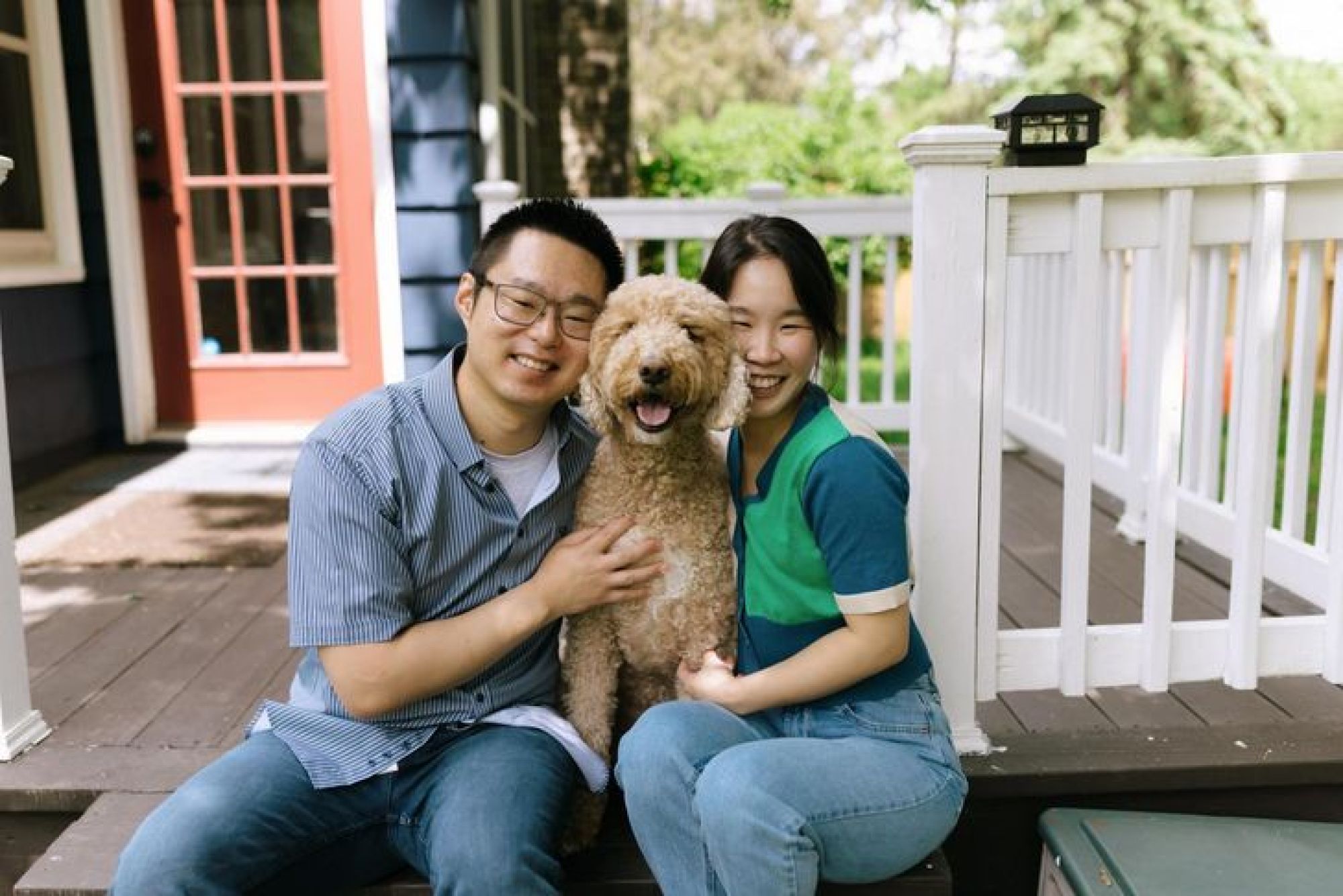
Back in Minnesota, he struggled, biking 3 miles to work at a meat shop since he couldn’t afford car insurance. Eventually he landed a corporate job as an executive speechwriter. He leaned on his friends. And he attended a Korean church, through which he met his future wife Shim Hye-in in spring 2018. He asked her out that summer, and she said yes.
On Sept. 8, 2018, Nik and Hye-in sat together on Nik’s 30th adoption anniversary. Hye-in listened as Nik’s adoptive mother reminisced about the day’s excitement and happiness.
“I had a weird, complicated feeling upon hearing that, because Nik had told me about a feeling of loss,” Hye-in said.
After dating for half a year, Nik and Hye-in visited Korea together in January 2019. They spent a day in Daegu, where Nik’s birth mother took to Hye-in and shared her life story.
That night, Hye-in debriefed Nik. He learned, for the first time, about how his birth mother had tried unsuccessfully to take him back. The next day, when it hit him, Nik pulled a blanket over his head and sobbed.
When Nik fully processed this years later in 2023, the thorny issues surrounding adoption crystallized for him.
“Adoptees,” Nik said, “remain the byproduct of a system that made money and completed someone else’s family.”
They visited Nik’s birth mother again in May 2024, another trip that ended in frustration.
He and Hye-in had taken the train to Daegu early in the morning, but his birth mother arrived late without communicating. For hours, she vented about troubles at work and home. By the time Nik and Hye-in returned to the train station, they were tired and relieved the day was over.
On the train, Nik told Hye-in he didn’t need to see his birth mother again for a while. Each interaction, including the reunion, had drained Nik — time spent in an area he wouldn’t usually visit, fraught with linguistic and cultural barriers. He realized he could reevaluate his boundaries.
They have not seen each other since, though Nik still considers his birth mother family.
A year after that trip, the complexities of adoption and the relationships affected would be thrust under the spotlight at the international level. Korea made waves in March 2025 when it formally admitted to malpractices and fraud in its adoption system.
When the Truth and Reconciliation Commission (TRC) released its report last March revealing illegalities in dozens of adoption cases, neither Nik nor Hye-in felt surprised.
The following month, the TRC suspended its investigation, leaving the remaining adoption cases in limbo until earlier this year, when the Assembly passed a bill for it to begin its third mandate. However, it may still take several more months until the investigations reopen.
In the meantime, adoptees continue to grapple with the meaning of kin. Nik and his birth mother have not seen each other since 2024, though Nik still considers her family. And he is sure of this: he feels most at home wherever he is with Hye-in.
“It’s the greatest feeling in the world,” Nik said. “What I thought was a journey of being as Korean as possible was a journey of finding commonality.”
News from:The Korea Times